
Blog
Why Richmond's Older Housing Stock Changes the Garage Door Job
Richmond's housing mostly went up between 1959 and 1988, before modern insulation codes. Here's what that means for your garage door and what it costs to fix.
The Seasonal Bit
Richmond sits in a cold-severe climate band, and that matters more for a garage door than most homeowners think. Cold doesn't just stiffen a spring overnight - it shrinks and swells the wood or steel panel seasonally, and on a door built to a 1960s or 70s spec, that movement finds every gap in the weatherstrip. If your house went up in that window, which covers most of the four main residential areas around town, your door was likely installed, or replaced, without the thermal break standards that came later. That's not a flaw in the door - it's a product of when it was built. What it means in practice: panels that sweat and frost on the inside face in January, bottom seals that go brittle and crack by February, and openers that strain harder in the cold because the door itself is doing less work holding heat in. None of this is an emergency by itself. It's wear that shows up on a schedule tied to the season, not to how the door is used. We see the same pattern across the older sections of Richmond every winter - it's the houses, not bad luck.
What You Pay
We don't have a flat number to quote you here, and we're not going to make one up. What we can tell you is that the jobs we see most in Richmond track the age of the housing - median household income here runs around $51,139, and most of the calls we get are repair jobs on doors and openers original or close to original to houses built between 1959 and 1988, not full replacements on new construction. That means parts availability matters as much as labor. A torsion spring or roller off a door from that era is usually still a stock part. A full panel match on an older steel door sometimes isn't, and that changes the job from a quick fix to a longer one. Be honest with yourself about this when you're deciding whether to repair or replace: if the door is from that original build era and the track or hardware is failing alongside the panel, patching it piece by piece can end up costing more over a year than one job done right. We'll tell you straight which category your door falls into before we start.
What Local Conditions Do
With roughly 6,658 owner-occupied houses across a service area of 16,654 households, and most of that stock concentrated in four areas built out mostly in the 1960s and 70s, the pattern we see isn't random - it's the housing talking. Doors from that era were hung on hardware that wasn't built for the insulation standards that came later, so cold-weather stress shows up at the same points, house after house: torsion springs sized for a lighter uninsulated panel straining against a heavier retrofit door, tracks that were never leveled for a slab that's settled over fifty-plus years, and openers original to the house working against both. The cold-severe climate band means this cycle - contraction, strain, failure - is a winter-to-winter thing here, not a once-a-decade thing. If your house falls in that 1959-1988 build window, which covers most of Richmond's residential stock, there's a decent chance your door or opener is original or a direct like-for-like replacement, and that's worth knowing before something breaks at 6am on the coldest day of the year.
The Problem
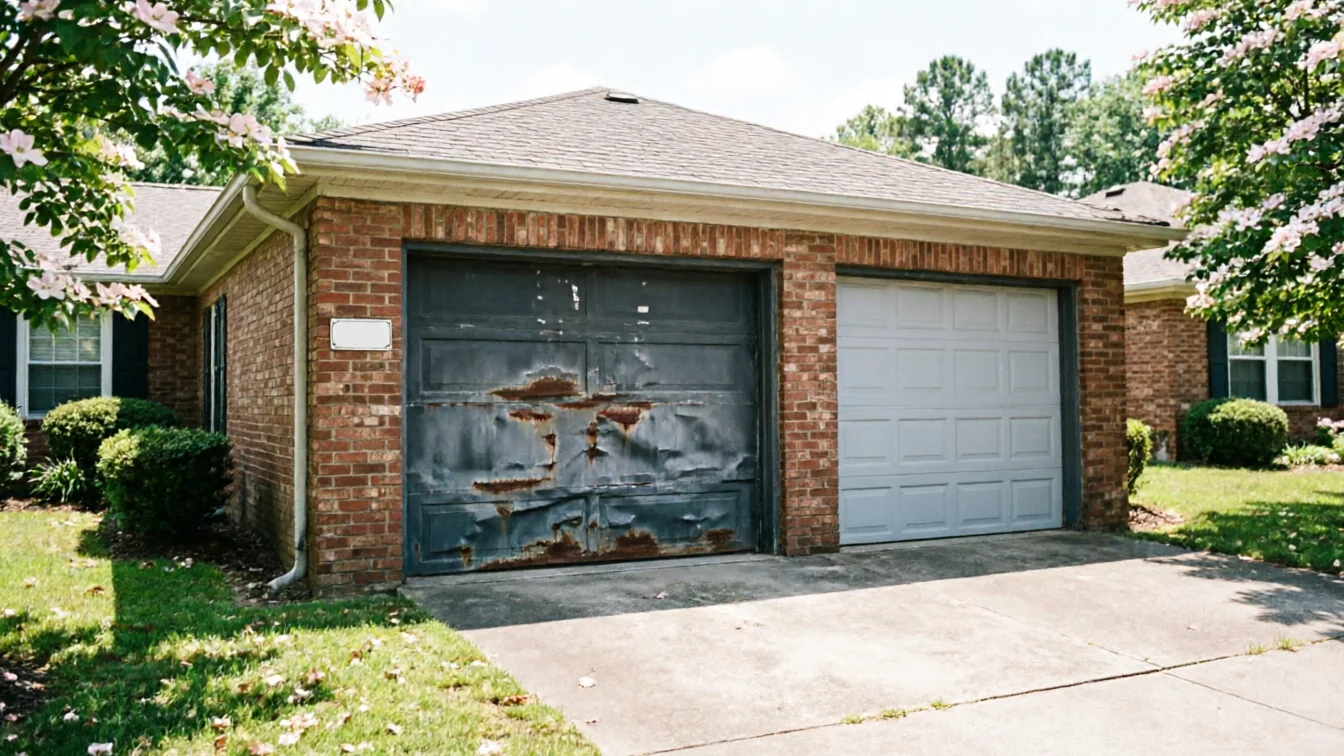
The core issue is simple: Richmond's housing stock is old enough that a lot of garage doors were installed before insulation rules changed what a 'normal' door is built to handle. That's not unique to one street or one neighborhood - it's baked into the build years across the four main residential areas, almost all of it 1959 to 1988. A door built to that older spec, paired with a cold-severe winter, means parts fail from material fatigue and temperature swing more than from misuse. We won't tell you every old door needs replacing - plenty of original hardware just needs a spring, a roller set, or a opener logic board. But when the panel itself is the problem - no insulation core, warped from decades of freeze-thaw - no amount of hardware repair fixes that. That's the point where we'll say so rather than keep billing you for patches.
Questions
Common questions
Why does my garage door freeze shut every winter?
If your house was built in the 1959-1988 window, which covers most of Richmond, your door likely has little to no insulation core. In a cold-severe climate, condensation on the inside panel face freezes to the weatherstrip and the frame overnight. It's a function of the door's age and material, not a sign something's broken - though a worn seal makes it worse.
Is it worth insulating an old garage door instead of replacing it?
Sometimes. If the panel and track are sound and it's just lacking a thermal core, an insulation kit can help. But if the steel is warped or the hardware is original and failing too, you're better off putting that money toward a door built to current standards. We'll look at the actual door before telling you which way to go.
Do you work outside Richmond?
We're based in Richmond and that's our primary service area. Berea, Lancaster, Irvine, and Winchester are all within a 10 to 20 mile range of us, so give us a call if you're in one of those towns and we can tell you whether it works for your job.
Recommendation
You Might Also Like
More garage door guides for Richmond homeowners.
What a Service Call Actually Covers in Richmond
Richmond's housing stock runs 1959-1988 with a severe cold climate band.
Read guide
Why Cold Snaps Break Springs on Richmond's Older Garages
Most Richmond, KY garages date to 1959-1988 and carry original hardware.
Read guide
Openers and Power Cuts in Richmond Homes
Richmond homes built 1959-1988 run openers that fail hard in winter power cuts.
Read guideReady when you are
Need a garage door sorted in Richmond?
Richmond Garage Door Pros repairs and installs garage doors, springs and openers in Richmond, KY and the surrounding area.